

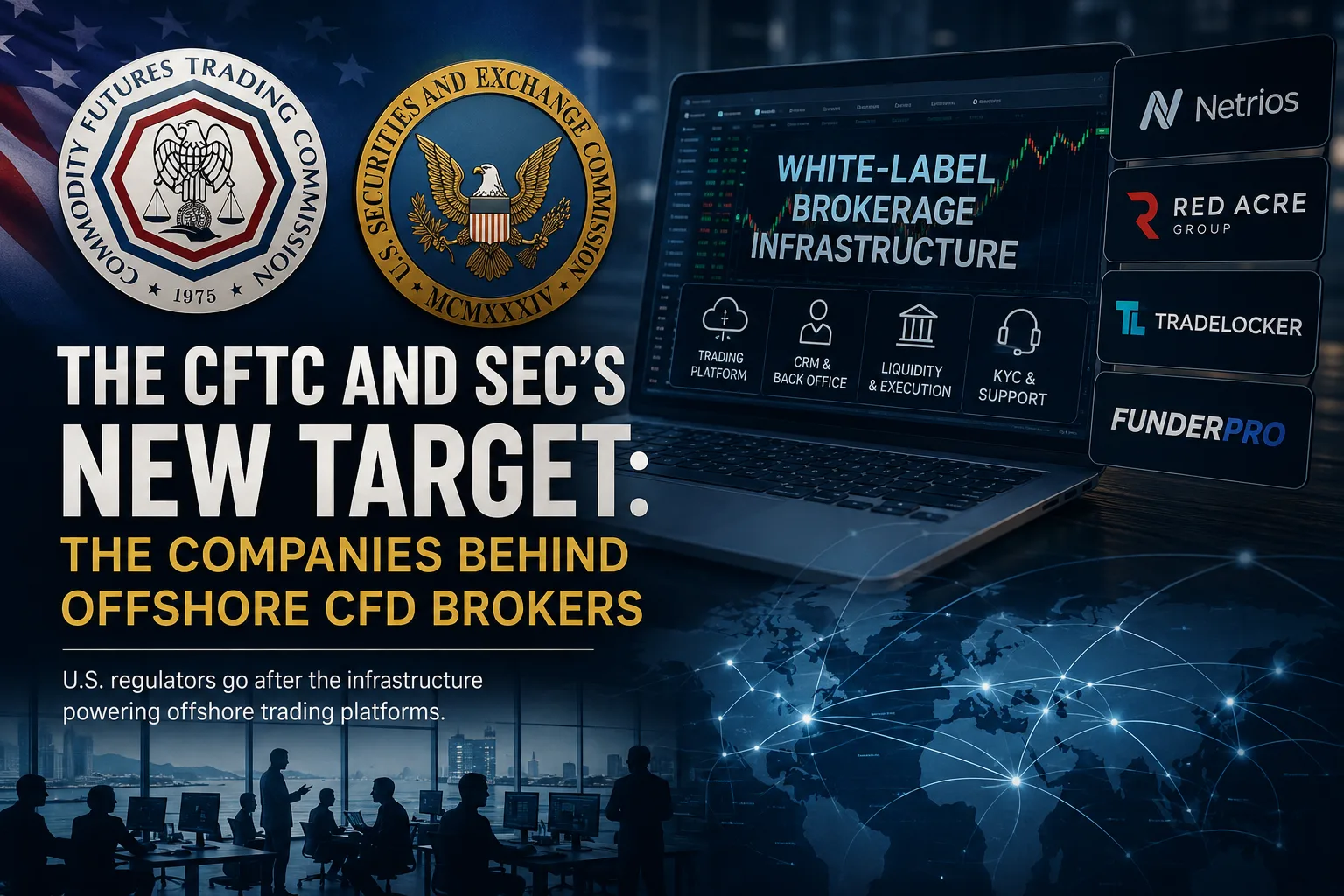
The Commodity Futures Trading Commission and the Securities and Exchange Commission have moved against Netrios LP Ltd. and Red Acre Ltd. in parallel settlements that put the infrastructure behind offshore CFD brokers under direct U.S. regulatory scrutiny. In a CFTC order dated June 26, 2026, Netrios was ordered to pay a $1.75 million civil monetary penalty and Red Acre was ordered to pay $750,000 for facilitating illegal off-exchange leveraged or margined retail commodity transactions involving U.S. customers who were not eligible contract participants. The SEC imposed the same penalty amounts in a separate administrative order dated June 29, 2026, bringing the total penalties across the two agencies to $5 million.
The size of the penalties is not the most important part of the case. The more important point is who was charged. The CFTC and SEC did not build their actions around a single offshore broker brand. They targeted the firms that allegedly created, operated and supported the white-label infrastructure used by multiple brokerages to offer CFDs and leveraged retail trading to U.S. customers.
That makes the Netrios and Red Acre case relevant far beyond the two respondents. It speaks directly to white-label providers, broker-as-a-service firms, CRM vendors, platform providers, liquidity providers, payment infrastructure firms, customer support outsourcers and the wider FX/CFD supply chain that sits behind offshore broker brands.
Netrios Built The Broker Stack, According To The SEC
The SEC order gives the clearest description of how the business worked. From at least 2019 until September 2025, Netrios offered and sold security-based swaps to U.S. retail investors through white-label brokerages, according to the Commission. Netrios created ready-to-operate online brokerage platforms that operators could run under their own brands, including at least fifteen white-label brokers that were owned and operated primarily from within the United States.
The products offered through those platforms included CFDs based on stocks, commodities and other assets. The SEC found that CFDs based on single stocks qualified as security-based swaps under federal securities laws because their value was based on a single security. Netrios allegedly offered those products without an effective SEC registration statement and without effecting the transactions on a registered national securities exchange.
The order describes a full operating model rather than a narrow software relationship. Netrios provided website creation, back-office services, liquidity, pricing, order execution, custodial services for customer funds and sublicenses for a third-party trading application. In some cases, Netrios also introduced white-label operators to service providers for the creation of overseas corporate entities.
Red Acre, an affiliate of Netrios, provided KYC verification, marketing and customer support services. According to the SEC, Red Acre helped customers with registration, deposits, withdrawals, software downloads and complaint resolution. It also provided default legal terms and conditions for white-label broker websites and carried out email and social media marketing services for some of the brokers.
This is the part of the case that should worry the brokerage infrastructure industry. The agencies are not treating the broker stack as invisible plumbing. They are looking at who designed it, who controlled it, who processed the data, who supplied the pricing, who handled the customer journey and who enabled the trading relationship.
The CFTC Focused On Forex, Metals And Crypto
The CFTC order focused on off-exchange leveraged or margined retail commodity transactions involving forex, metals and cryptocurrencies. The agency found that Netrios provided technology and infrastructure to white-label entities so they could offer leveraged or margined retail commodity transactions to U.S. residents who were not eligible contract participants.
Under U.S. law, these transactions cannot simply be offered to ordinary retail customers from an offshore platform. The CFTC said the transactions did not result in actual delivery within 28 days and were not conducted on or subject to the rules of a CFTC-designated contract market. As a result, the agency found that Netrios violated Section 4(a) of the Commodity Exchange Act.
The CFTC also found that Red Acre aided and abetted Netrios by providing customer and technical support to white-label customers, including non-ECP U.S. customers, as well as marketing services. The order states that Red Acre knew of and intentionally assisted Netrios’ efforts to conduct leveraged or margined retail commodity transactions with U.S. customers.
The SEC and CFTC actions therefore split the same broader business across two regulatory frames. The CFTC addressed leveraged retail commodity transactions tied to forex, metals and crypto. The SEC addressed security-based CFDs tied to single stocks and securities. Together, they show how a multi-asset CFD platform can trigger several parts of the U.S. regulatory system at the same time.
Why The U.S. Treats CFDs Differently
The case also highlights the long-standing divide between the United States and the global FX/CFD industry. CFDs are widely offered in jurisdictions such as the United Kingdom, Australia, Cyprus, South Africa and other international markets. The U.S. has taken a different approach. Retail CFDs are effectively outside the mainstream U.S. brokerage model, and leveraged off-exchange retail derivatives face strict restrictions unless they are offered through registered structures.
That is why offshore brokers often block U.S. residents, reject U.S. documents, restrict U.S. IP addresses and include U.S. exclusions in their terms. The Netrios case shows why those controls cannot be cosmetic. According to the SEC, U.S. residents were permitted to register and trade through the white-label brokers, and U.S. residents made up the majority of customer accounts at some of those brokerages. Customers were not required to provide information such as proof of total assets or invested amounts, meaning there was no attempt to verify whether they were eligible contract participants.
The eligible contract participant threshold is central to the case. It separates sophisticated or institutional counterparties from ordinary retail customers. The CFTC and SEC both concluded that the white-label broker model supported by Netrios and Red Acre failed at that point. U.S. customers were able to access products that the agencies say should not have been made available to them through those offshore structures.
This is also why the case sits alongside broader U.S. debates over where retail derivatives belong. FinanceFeeds has reported on the CFTC and SEC moving to clarify swaps rules as crypto perpetuals, swaps and retail derivatives continue to test the boundary between innovation and regulatory arbitrage. The same issue appears in the growth of regulated alternatives, including CFTC-regulated crypto perpetual futures and event contracts inside U.S. market infrastructure.
The Red Acre, TradeLocker And FunderPro Connection
The case has also attracted attention because Red Acre is connected to a wider broker technology and prop trading ecosystem. Public material describes Netrios as part of the Red Acre Group, and industry reporting has linked Red Acre to TradeLocker and FunderPro. TradeLocker is known as a trading platform used by brokers and prop firms, while FunderPro operates in the prop trading sector.
That connection is relevant context, but it must be framed precisely. Neither the CFTC nor the SEC charged TradeLocker, FunderPro or NextTrade. Neither order alleges wrongdoing by those businesses. The respondents in the U.S. enforcement actions are Netrios LP Ltd. and Red Acre Ltd.
The distinction matters because the regulatory issue is not whether a group has other businesses in trading technology. The issue is whether the charged entities created and supported infrastructure that enabled U.S. retail customers to access unlawful off-exchange leveraged products. The CFTC and SEC orders focus on Netrios’ white-label broker infrastructure and Red Acre’s KYC, support and marketing services.
The broader connection still matters for the industry because it shows how modern trading businesses are often built as ecosystems. A single group can touch platform technology, white-label brokerage services, prop trading, payments, support, onboarding and marketing. That structure can create operational scale, but it also creates regulatory exposure when one part of the ecosystem serves restricted customers or products.
White-Label Technology Is Not The Problem
The orders do not say that white-label brokerage technology is unlawful. White-label platforms are a normal part of the FX and CFD market. Brokers use third-party technology for trading platforms, bridges, liquidity aggregation, CRM, client portals, onboarding, payments and analytics. FinanceFeeds recently reported on Scope Prime and Centroid targeting the brokerage infrastructure boom with a white-label multi-asset platform, showing how central outsourced technology has become to broker launches.
FinanceFeeds has also covered DXtrade adding Pelican’s copy trading to white-label infrastructure and Quadcode SaaS launching a white-label brokerage platform. Those examples show that white-label infrastructure is a mainstream industry model.
The Netrios case is different because regulators found that the infrastructure was used to offer restricted products to U.S. retail customers. The more complete the outsourced service becomes, the more difficult it may be for a provider to argue that it is merely selling neutral software. Netrios allegedly supplied the website, trading infrastructure, pricing, liquidity, order execution, custody functions, customer account data and transaction records. Red Acre allegedly supplied KYC, legal terms, support and marketing. That is a full brokerage operating environment.
The Infrastructure Layer Is Now In The Enforcement Perimeter
The case expands the risk map for the FX/CFD industry. Historically, U.S. enforcement actions against offshore retail trading activity often focused on the broker brand, the operator, the promoter or the individual behind the solicitation. This action moves closer to the operating layer behind the broker.
That has consequences for several types of firms. White-label providers may need to review whether their clients can onboard U.S. residents. CRM vendors may need stronger controls around restricted jurisdictions and customer categorization. Platform providers may need to understand which products are enabled by default. Liquidity and execution providers may need clearer contractual protections where offshore brokers serve high-risk jurisdictions. Customer support outsourcers may face greater scrutiny if they help restricted customers register, deposit, trade or withdraw.
This does not mean every vendor becomes liable for every broker client. It does mean that regulators can look through the brand and examine who actually made the activity possible. If a provider controls pricing, liquidity, execution, account balances, customer data, onboarding workflows and support, it may become part of the regulated activity in the eyes of U.S. agencies.
The same principle is visible in other parts of the U.S. market. FinanceFeeds has reported on offshore prediction markets drawing U.S. traders despite CFTC restrictions, where the key distinction is not whether the product exists globally, but whether U.S. customers can access it outside a registered framework. That logic now applies directly to offshore CFD infrastructure.
Regulated U.S. Access Is The Alternative
The U.S. is not closing the door to retail derivatives altogether. It is pushing that activity into regulated venues and supervised structures. FinanceFeeds has covered Plus500’s launch of CFTC-regulated sports event contracts, Crypto.com’s CFTC approval for U.S. margined derivatives and the CFTC opening a route for offshore crypto exchanges to register for U.S. clients.
The contrast is important. The U.S. may allow retail traders to access more sophisticated markets, but it wants that access to occur through registered exchanges, clearing structures, supervised intermediaries and compliant product design. The offshore CFD model conflicts with that approach when U.S. residents can open accounts, fund with crypto assets and trade leveraged products without the required regulatory checks.
For international brokers, this creates a clear strategic choice. They can stay outside the United States and build serious controls to exclude U.S. customers, or they can pursue regulated U.S. routes. What they cannot safely do is rely on offshore incorporation, branded websites and weak onboarding controls while U.S. retail customers continue to trade.
International Cooperation Raises The Pressure
The CFTC thanked the SEC, the Central Bank of Ireland, the Financial Services Authority of Seychelles and the Malta Financial Services Authority for assistance. That cooperation is significant because offshore broker structures are rarely confined to one country. A legal entity may sit in one jurisdiction, the technology provider in another, support teams elsewhere, payment flows in crypto assets and customers spread across several markets.
Cross-border cooperation allows regulators to reconstruct those structures. It also reduces the value of fragmented corporate arrangements if the operational reality points back to U.S. customers and restricted products. The SEC order says Netrios operated remotely with employees in multiple locations outside the United States, while Red Acre was incorporated in Malta with business operations in Malta. The CFTC also noted assistance from Seychelles and Ireland, showing that the inquiry extended across several regulatory touchpoints.
That matters for the wider FX/CFD sector. Offshore structures can still be lawful, but they are less protective when the business model depends on prohibited customer access. Regulators are increasingly willing to connect the corporate, technical and operational pieces.
A Warning To The Companies Behind The Broker
The Netrios and Red Acre settlements should not be read as a routine offshore broker case. They are more significant because they target the machinery behind the broker brand.
The CFTC found that Netrios carried out activities that lawfully could only be performed on a CFTC-registered exchange. The SEC found that Netrios offered and sold security-based swaps without registration and outside a registered national securities exchange. Red Acre was found by the SEC to have caused Netrios’ violations, and by the CFTC to have aided and abetted Netrios’ unlawful conduct.
For the FX/CFD industry, the message is direct. U.S. regulators are no longer focused only on the company name on the trading website. They are also looking at the companies that build the website, supply the infrastructure, process the onboarding, support the customer, provide the liquidity, execute the orders and control the data.
The CFTC and SEC’s new target is the company behind the offshore CFD broker. That changes the compliance calculation for the entire retail trading supply chain.